Design your data model
in minutes, not hours
Four ways to build your schema - AI-powered generation, a visual drag-and-drop editor, SQL/JSON import, or pre-built templates. One universal format that works across SQL and NoSQL.
Four Ways to Start
Pick the starting point that works best for you
AI-Powered
Describe your data model in plain English. SynthForge IO extracts entities, infers relationships, and assigns field types automatically.
"I need an e-commerce schema with users, orders, and products"
Visual Editor
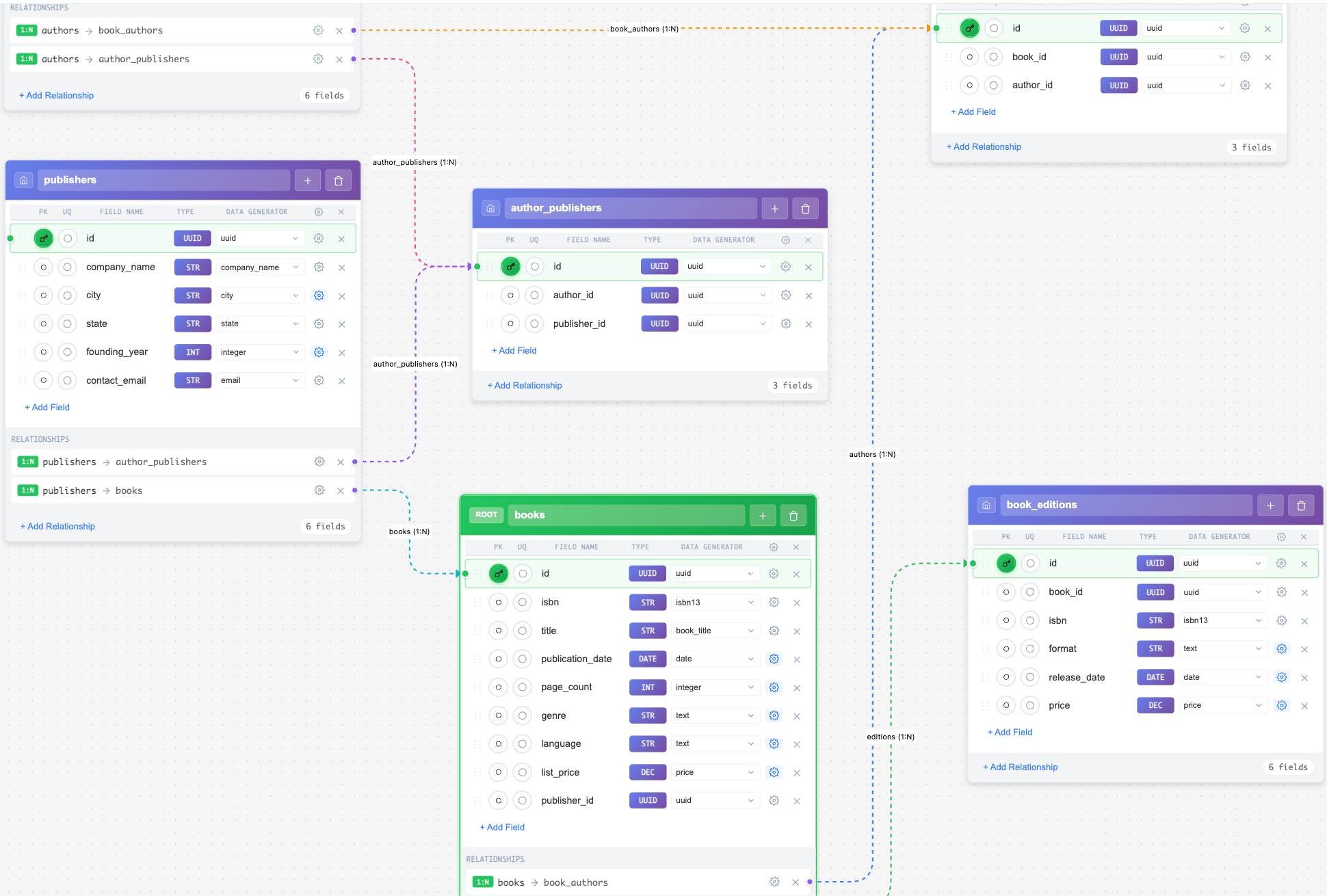
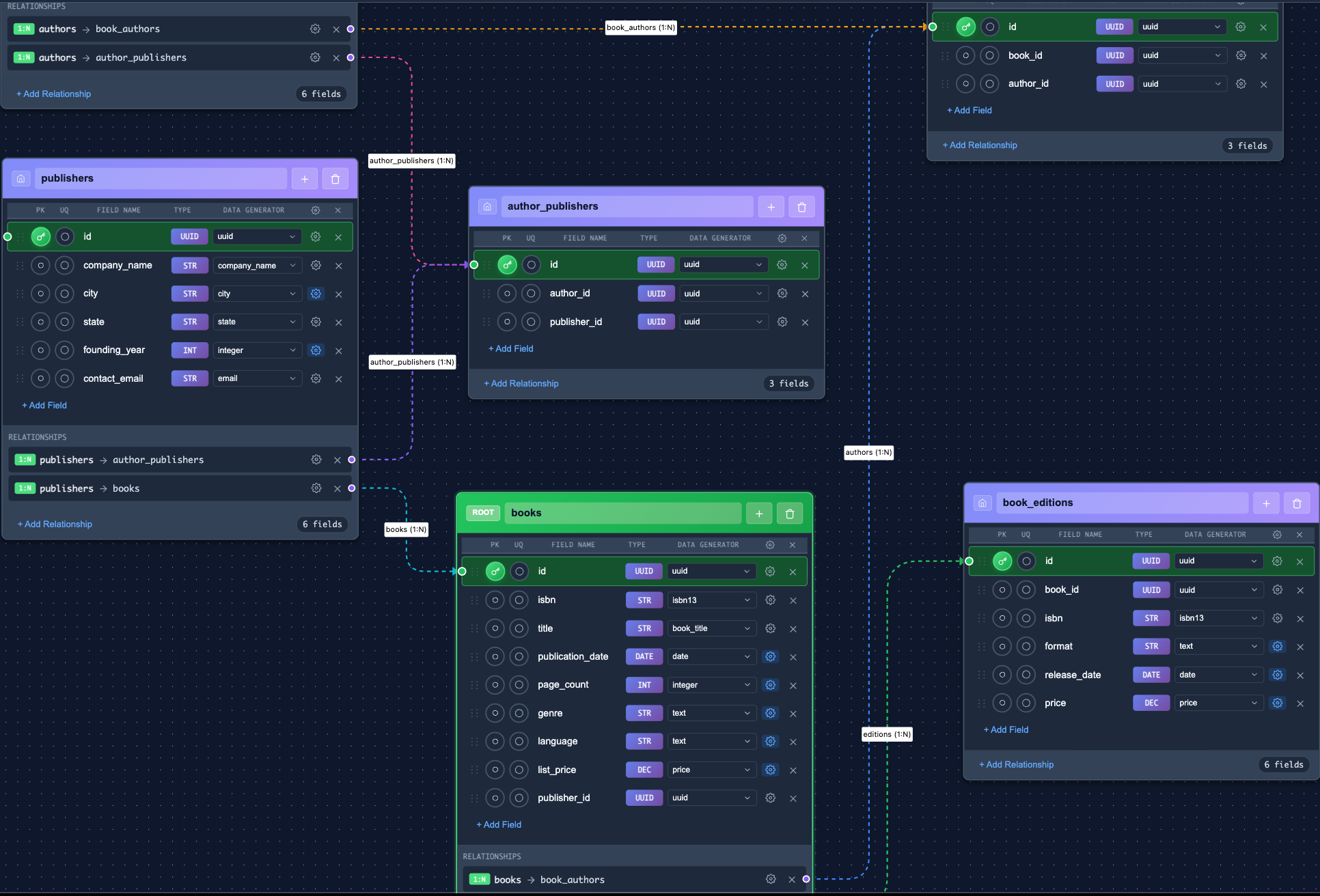
Drag-and-drop tables, draw relationship lines, and preview sample data in real-time with minimap and zoom controls.
Import Existing
Paste SQL DDL from any of seven supported dialects. The LLM-based importer pulls out tables, columns, primary keys, and foreign-key relationships.
Built-in Templates
Start with a pre-built schema for common domains. Customize tables, fields, and relationships to match your needs.
Two-Pass AI Architecture
Two specialized AI agents work in sequence, followed by the data generation engine.
Schema Structure Agent
Extracts entities, fields, and relationships from your description. Determines data types and identifies foreign key dependencies between tables.
Field Generation Agent
Assigns semantic field types (like email, phone_number, company_name) and constraints based on field names and context.
Generation Engine
Parallel processing and automatic dependency ordering produce correct generation across complex multi-table schemas.
One Schema. SQL or NoSQL.
A universal data model that works across database paradigms
SynthForge IO uses a universal schema format built on well-known relationship patterns - 1:1, 1:N, and (via explicit junction tables) M:N. Define your model once, then export DDL plus data for any of seven SQL dialects: PostgreSQL, MySQL, SQL Server, SQLite, MariaDB, DuckDB, CockroachDB. The same dataset emits as JSON or JSONL ready for mongoimport.
+SQLite, MariaDB, DuckDB, CockroachDB
Universal
Schema
1:1 / 1:N / M:N
Referential integrity. Every time.
The one thing that makes synthetic data actually work.
What We Guarantee
-
Foreign keys always reference valid parent IDs
No orphaned records. Every child row points to an existing parent.
-
Cardinality constraints respected
1:1 relationships generate exactly one child per parent. 1:M respects your specified distribution.
-
Topological generation order
Parents are always generated before children. Dependency order is automatic.
-
Circular dependency detection
The schema editor automatically detects impossible circular foreign key relationships and warns you before generation.
Relationship Types Supported
One-to-One (1:1)
User profiles, configuration settings, extended attributes
One-to-Many (1:M)
Customers with orders, authors with books, departments with employees
Many-to-Many (M:M)
Students and courses, products and categories, tags and articles
Hierarchies (via edge table)
Employees with managers, categories with parents, comment threads with replies. A table cannot reference itself, so model the hierarchy as a separate edge table holding both sides of the link.
Frequently Asked Questions
How does AI schema generation work in SynthForge IO?
Describe your data model in plain English (e.g., 'I need an e-commerce schema with users, orders, and products'). SynthForge IO uses a two-pass AI architecture: the first agent extracts entities, fields, and relationships, while the second assigns semantic field types and constraints. The result is a complete, editable schema with foreign keys and realistic data types.
What import formats does SynthForge IO support?
SynthForge IO can import SQL DDL across the same seven dialects it generates for: PostgreSQL, MySQL, SQL Server, MariaDB, SQLite, DuckDB, and CockroachDB. The importer pulls out tables, columns, primary keys, and single-column foreign-key relationships. JSON Schema and MongoDB-collection import are on the roadmap, not currently shipped.
How does SynthForge IO handle relationships between tables?
SynthForge IO supports one-to-one (1:1) and one-to-many (1:N) relationships natively via single-column foreign keys. Many-to-many (M:N) is modeled with an explicit junction table containing two FKs - both the AI schema designer and the visual editor handle this idiomatically. A table cannot carry a foreign key to itself (employees.manager_id -> employees.id), so model hierarchies as a separate edge table with two FKs to the entity table, for example reporting_lines.employee_id and reporting_lines.manager_id both pointing at employees.id. All relationships maintain referential integrity: tables are generated in topological order so parents exist before children, and child FK values are sampled from parent IDs that already exist.
Can SynthForge IO generate schemas for both SQL and NoSQL databases?
SynthForge IO is primarily relational-first: design tables with foreign keys, export DDL plus data for any of seven SQL dialects. For MongoDB, the same dataset is emitted as JSON or JSONL that you load via mongoimport. Native MongoDB-collection-shaped output (with embedded documents) is on the roadmap; today's MongoDB path is JSON / JSONL ingest.
Turn Your Idea Into a Data Model
Describe it in plain English, draw it visually, or import existing DDL. SynthForge IO handles the rest.